 |
| Photo from Pixabay. |
Readers may have seen the kerfuffle between Dr. Robert Malone and journalist Alex Berenson. They were both guests on Fox News to talk about big tech censorship when Berenson, apropos of nothing, accused Dr. Malone of inflating his credentials and misleading people about ivermectin. After the interview, Malone immediately listed several of his patents and papers on his substack; Berenson so far hasn't produced any evidence to back up his accusations. And the accusations have blown up in his face: readers are unsubscribing to his substack, Unreported Truths, en masse and supporters are closing their wallets. Many of them have gone over to the substack of Robert Malone.
I haven't seen anything like this since Denise Minger debunked The China Study. Even the documentary Fathead, which debunked Supersize Me, didn't seem to cause such an uproar. But both Minger and Tom Naughton (who made Fathead) brought the receipts and neither The China Study nor Supersize Me stood up to their mathematical and scientific scrutiny.
So why did Alex Berenson make accusations without backing them up? My best guess, based on his book Pandemia, is that his physician wife and their New York City friends are very unhappy with his stance on the COVID vaccines and his appearances on Fox News. Perhaps he also wanted to shake off the wing nuts in his audience. Many of the comments on his substack are batshit crazy theories about depopulation and election fraud that would never be approved here on Pain, Pain, Go Away. Maybe he figured trying to discredit Dr. Malone would run off the nutters and placate his wife at the same time. If so, he's likely succeeded--more than he intended.
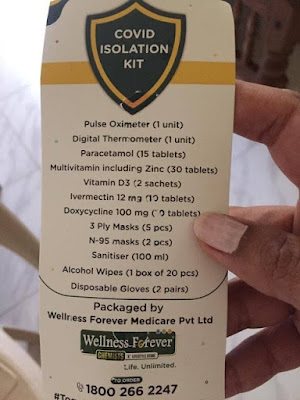
Dr. Malone followed up with a post about ivermectin in Uttar Pradesh. This site shows they've had a very low death rate compared to other Indian states, and other states mentioned in various news sources as using ivermectin likewise have had low death rates. So this is some observational evidence that ivermectin is helpful against COVID. (Others have dived far more deeply into this subject than I'm willing or able to.) He adds that a colleague on vacation in India sent him a picture of one of the COVID care packages distributed throughout the region:
 |
| Source: https://rwmalonemd.substack.com/p/socrates-thought-police-ivermectin |
Assuming the contents of this pack are saving people from dying of COVID, could the other ingredients be having an effect? Paracetamol is Tylenol, so likely nothing more than a pain reliever. Zinc--possibly. D3? Two doses, even two big ones, may or may not have much effect since it takes time for your body to build up its vitamin D level. Doxycycline is an antibiotic and an anti-inflammatory; this study didn't show any benefit for COVID patients. So maybe ivermectin is helping people.
It may not matter much at this point. It's almost all Omicron now. Even here in Indiana, where we've lagged most other places, cases are starting to go down in Indianapolis and the outskirts of Chicago. My coworkers in the suburbs of Indy are catching COVID left and right, yet I haven't heard about a serious case among them. I feel left out! One person thought I had immunity from the colds I've caught; another thought my blood type (O) helped. Thanks to immunity and repurposed drugs being treated as stepchildren, we'll probably never get a good answer to any of these questions.
Alex Berenson has written recently that COVID is over and boosters are over. Be that as it may, COVID vaccine injuries, health agency malfeasance, and the effects of the government response, all of which he writes about, are all still important. He's done some terrific reporting (aside from his latest appearance on Fox News) and for that reason I'm keeping him on the blog roll. I still recommend his book Pandemia. If the quality of his reporting diminishes, though, I will revisit the decision to support his work.
Comments