
Fruit Fail

My healthy diet doesn't include fruit. Shocked? You're not alone: this surprises people who continually hear "eat lots of fruits and vegetables!"

I initially stopped eating fruit when I read Norm Robillard's theory of carbohydrates causing acid reflux in susceptible individuals. I found fruit to be the worst food for giving me acid reflux, and I've rarely touched it since. Anytime I have, I've almost always regretted it within 20 minutes. Non-starchy vegetables quickly became a much bigger part of my diet: they're low-carb and full of nutrients.

Am I missing anything by avoiding fruit? Lots of vitamin C and fiber? I made a chart to find out. Using Nutritiondata.com, I chose five fruits and five vegetables that I eat (or used to eat) and looked up how much of certain vitamins they contained. I chose vitamins that most of them had at least of little of. I also noted their total carb and fiber content.
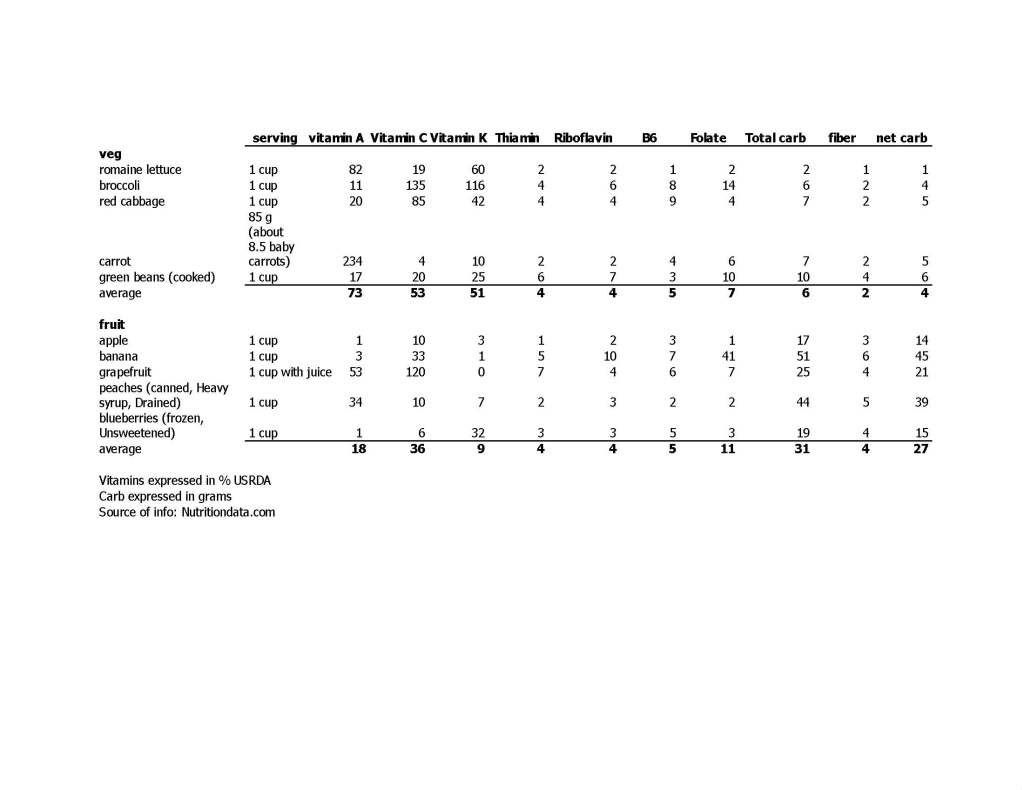


(Click for larger image.) Note that the bottom lines are averages, not totals. (I never ate five cups of fruits or veg a day; I doubt many people do.) For vitamins A, C and K, the vegetables listed are the runaway winners. Vitamins A and K are fat soluble, meaning they have to be eaten with fat to be absorbed. How often do people eat the fruits listed with something that has fat in it? I know I didn't before going low-carb. I eat veg with salad dressing, butter, olive oil or ranch dip.

It looks like I'd get a little bit more folate and two more grams of fiber from the fruit--and a lot more carbohydrate--23 grams per cup, on average. The carbohydrate in fruit is mostly sugar. It may be natural, but it's still sugar. If you're concerned about blood glucose levels, weight gain, your teeth, and a variety of other health issues, sugar in anything but very modest amounts is bad news.

Comments

Brooksie said…
Thanks for sharing this, I eat about two pieces of fruit a month and have done this for several years now. I cut way back on fruit consumption because is bothers my hypoglycemia, I pretty much listen to what my body tells me to do and I find that works the best. I am glad to know I am not alone.
Lori Miller said…
Brooksie, you're definitely not alone in eating very little fruit. My mom mostly leaves it alone (it jacks up her blood sugar) and Norm Robillard says he generally avoids it, too. Robillard adds that he uses a squirt of lemon or lime for flavoring, as do I. Dr. Atkins wrote that he had some patients who were so carb intolerant that they couldn't even eat the green salads he recommended on his diet.

Popular posts from this blog

Not Only Cheaper, But Easier

A while back, I wrote about saving money on break time coffee and snacks. I haven't done very well putting it into practice. But a post by James Clear today got me thinking about it again: Warren Buffett uses a two-list system to prioritize things. Check it out --and follow the instructions. Using Buffett's two-list system, two of the goals I ended up with were taking care of myself and saving $400 more per month than I already am. As I said, I've been wanting to save money, and the system made me really focus on this. I came up with 11 money-saving ideas, six of which had to do with food. Buying hamburger in bulk. Ranch Foods Direct sells one-pound packages of 80% lean pastured ground beef in bundles of 20 for a lot less than Whole Foods. Sprouts only carries super-lean beef that's grass-fed, and it's more expensive, too.  Not driving to Whole Foods. Whole Foods is out of my way, and saving a weekly trip saves gas. Coffee at home, tea at work. Tea is fr...

We Hate the ADA; Why does the Perfect Health Diet Get a Pass?

Some people keep touting the Perfect Health Diet as low-carb, but carb levels that are mostly in the triple digits aren't generally regarded as low-carb; in fact, one of the authors says low-carb diets are unhealthy. A lot of us hate the  American Diabetes Association's advice for diabetics: start with 45g to 60g of carbohydrate per meal and go higher or lower from there. That's 135g to 180g of carb. Perfect Health Diet advice for diabetics: eat 20% to 30% of your diet as carbohydrate. On 2,000 calories, that's 100g to 150g of carb. On 1,700 calories, that's 85 to 128g; on 2,200 calories, that's 112 to 168g. Depending on your carb and calorie intake, carbs would be 85g to 168g per day. That's not a mile off from the ADA's recommendations. Paul Jaminet, one of the authors of the Perfect Health Diet, says, "the basic biology here is that the body's physiology is optimized for a carbohydrate intake of about 30%." He warns against a ...

Palpitations Gone with Iron

Thanks to my internet friend Larcana, who alerted me to the connection between iron deficiency and palpitations, I doubled down on my iron supplements and, for good measure, washed them down with Emergen-C. It's a cold medicine with a mega-dose of vitamin C, plus B vitamins and minerals. I don't think vitamin C does anything for a cold (a friend bought the stuff and left it at my house the last time she visited), but vitamin C does help iron absorption. After doubling up on iron in the last three days, I feel back to normal. (I'd already been taking quite a bit of magnesium and potassium, so I probably had sufficient levels of those.) How did I get so low on iron? Maybe it was too many Quest bars instead of red meat when I had odd cravings during my dental infection recently. Maybe because it's too hard to find liver at the grocery store and I haven't eaten much of it lately. Maybe the antibiotics damaged my intestines . And apparently, I'm a heavy bleeder . ...

This Just In: Yogurt Doesn't Improve Health

A recent study from Spain finds "In comparison with people that did not eat yogurt, those who ate this dairy product regularly did not display any significant improvement in their score on the physical component of quality of life, and although there was a slight improvement mentally, this was not statistically significant," states López-García. Most yogurt is pretty much pudding with a little bacteria . Pudding is a sugar bomb. Hard to believe the stuff doesn't improve health outcomes, isn't it? But as usual, researchers are calling for...more research. "For future research more specific instruments must be used which may increase the probability of finding a potential benefit of this food."

My Long-Term Experience Eating Safe (and Other) Starches

Years ago, before the Perfect Health Diet came out, I followed a program that involved eating quite a bit "safe starch." It was called Body for Life. It involved eating six small servings of carbohydrate along with six small servings of protein, plus two servings of fibrous vegetables per day. (A serving was the size of your fist or the palm of your hand.) There were six workouts a week (three weightlifting, three cardio) and one free day every week where you ate whatever you wanted and didn't exercise. In all fairness, these two programs are different: BFL allows certain grains, legumes and low-fat dairy and discourages fat. It doesn't call for a wheelbarrow full of vegetation. Nevertheless, my experience eating lots of fruit and lots of starch is relevant to the PHD because the amount and type of digestible carbohydrates are similar, and for the first few years, I didn't eat wheat except on free days. At first on BFL, I felt great. Before, I was continually...