Living in the city presents some problems with housing chickens. Chicken coops are expensive and yet so tiny that they seem like six-chicken CAFOs. Electric fencing is forbidden. Regular fencing is hard work to build, and it's permanent. If the chickens don't work out, you're stuck with a fence you probably won't need or want.
Living in the city presents some advantages, though. The biggest, toughest predators are dogs; aerial predators like owls and hawks probably don't hang around your place. And the city itself can be a source of inspiration for solving your problems.
Like free-range chickens, festivals and construction sites have to be fenced off. Around here, we use portable chain link fencing. Taking a cue from that, I built a six-foot by four-foot freestanding fence panel out of scrap wood and wire fencing.

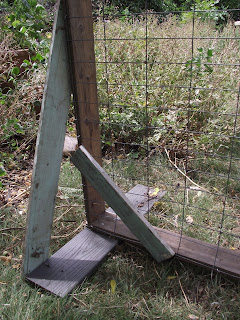
I used 1/2" x 3s to make a 6' x 4' box, joining the pieces with metal angle braces that sit on the edge (see top photo). I flipped the box over and put on the fencing using U-shaped stapled that have to be hammered in. Next, I hammered in diagonal braces cut to 15-1/2" inches to make the box secure. I screwed the box to 2' plastic decking boards, then nailed two diagonal braces onto the outside of the box and the decking boards.
I will probably replace the 2' decking boards with 3' or 4' boards to make the panel harder to tip over. Two-foot boards would probably be fine for a freestanding trellis or as a barrier against a little dog, but my dog Molly is a 68-pound brute who goes berserk around birds. I'll change the boards outside so I don't end up with a panel I can't get out of my garage. You could put a board across the middle if you plan to move the panel very often.
I'll probably also replace the nails with screws. Some of the nails came loose while I was moving the panel. Since the panel is a little unwieldy, I don't suggest making it any larger than 4' x 6'.
Living in the city presents some advantages, though. The biggest, toughest predators are dogs; aerial predators like owls and hawks probably don't hang around your place. And the city itself can be a source of inspiration for solving your problems.
Like free-range chickens, festivals and construction sites have to be fenced off. Around here, we use portable chain link fencing. Taking a cue from that, I built a six-foot by four-foot freestanding fence panel out of scrap wood and wire fencing.


I used 1/2" x 3s to make a 6' x 4' box, joining the pieces with metal angle braces that sit on the edge (see top photo). I flipped the box over and put on the fencing using U-shaped stapled that have to be hammered in. Next, I hammered in diagonal braces cut to 15-1/2" inches to make the box secure. I screwed the box to 2' plastic decking boards, then nailed two diagonal braces onto the outside of the box and the decking boards.
I will probably replace the 2' decking boards with 3' or 4' boards to make the panel harder to tip over. Two-foot boards would probably be fine for a freestanding trellis or as a barrier against a little dog, but my dog Molly is a 68-pound brute who goes berserk around birds. I'll change the boards outside so I don't end up with a panel I can't get out of my garage. You could put a board across the middle if you plan to move the panel very often.
I'll probably also replace the nails with screws. Some of the nails came loose while I was moving the panel. Since the panel is a little unwieldy, I don't suggest making it any larger than 4' x 6'.
Comments
All the best Jan