My Mom's Heel has Healed


Time may heal all wounds, but zinc may help them faster.

Three years ago, my diabetic mother developed a sore on her heel. According to my father, who has been dressing the wound during those years, it was the size of a silver dollar (1.5" diameter) and all the way to the bone--about 3/4." Their doctors refused to treat it and sent them to the hospital instead. Over the years, doctors, nurses, aides and my father have been dressing it, treating it with medicinal honey, and cutting away crusty skin around it in a painful, weekly doctor's office procedure. In three years, the size of the wound went down to the size of a quarter (1") and 1/16" deep. It still required the aforementioned care.

Having had such good results with zinc healing my nose from septoplasy (I'd had nosebleeds for ten years after the surgery), I gave my mom a bottle of 100mg zinc tablets two weeks ago. She's been taking one every day. The results, according to my parents:

The wound is now the size of a nickel (.83" inches) and superficial with a hard coating on it. There's no dead skin to be trimmed. In other words, it's practically healed.

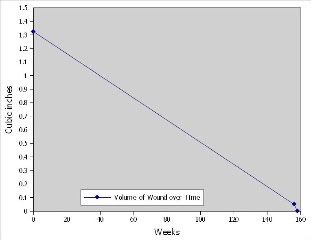
The wound healed quite a bit over the three years, though. Did the zinc tablets speed up the healing? I plotted wound volume over time. Of course, this is an approximation without exact measurements, relying on my father's memory, and with only a few data points over a long time. Nevertheless, I did it. Initial volume was about 1.35 cubic inches (my father said the wound had a slight taper on the inside, but was approximately cylinder shaped; volume two weeks ago was .05 cubic inches; and final volume was zero (with no depth, there's no volume).

Again, given the lack of data, this is iffy, but the sharp downward turn at the end of the graph indicating faster healing is encouraging.

I'd like to thank the people at Gnome, the free software desktop project. Without their Gnumeric spreadsheet software, I wouldn't have been able to create and post the graph at the top. What was Microsoft thinking when it developed Excel 2007, the Mickey Mouse version?

ETA: Last night when I visited my parents, I noticed that a three-year-old sore on my mom's ear was almost healed. (She fell asleep with a small speaker on her ear and it burned her.) I've seen this sore over the course of three years, and it didn't heal even a little bit. It's now nearly gone.

ETA, 9/10/10: My mom still has a nurse come by to tend her heel wound. (Without the nurse, she cannot have someone give her a shower, which she can't do by herself.) She told me last night that she'd stopped taking the zinc because one doctor or another told her to. "Why?" I asked. "Well, I don't know." As Michael Eades is fond of saying, Jesus wept.

Comments

Popular posts from this blog

Dana Carpender's Podcast; Dr. Davis on YouTube; Labor Day Sales

Dana Carpender, who's written several recipe books and other works on low-carb, has a podcast and is still writing articles at carbsmart.com. She's a terrific writer and amateur researcher (otherwise known as reading , as Jimmy Dore jokes ). I use her book 500 Low-Carb Recipes all the time and I'm looking forward to hearing more from her. I've embedded her podcast on my blog (click on the three lines at the top right if you don't see it, or go to Spotify or other podcast source if you're getting this by email). Carbsmart.com doesn't seem to have a blog feed, so if you want to see the latest posts there, you can sign up for notifications at their site. Dr. Davis has been putting a lot more videos on YouTube, so I've added his channel to the lineup. Click on the three lines on my blog if you don't see it, or go to his channel here .  * * * * * Primal Kitchen is having a Labor Day sale-- 20% off everything. They sell high quality collagen powder, con...

Fermented bread and butter pickle recipe ft. L. Plantarum

After Dr. Davis said the other night that  L. plantarum  may reduce some of the effects of the herbicide glyphosate (which is everywhere), I'm re-running my recipe for fermented bread and butter pickles. Pickling cucumbers naturally have  L. plantarum  bacteria on them, and fermenting them with some brown sugar multiplies these bacteria. (Just don't use chlorinated water to wash them.) And if you're growing your own cucumbers, avoid spraying the fruits with  Bacillus thuringiensis , or Bt (leaves and vines are OK). It's unclear what effect a big dose of Bt would have on humans. Another benefit of DIY pickles: no emulsifiers like polysorbate 80, which is a common ingredient in pickles. If you have GI problems, it could be from emulsifiers. These sweet-and-sour pickles are the tastiest I've ever made. There's just a little added sugar (some of which the bacteria will consume) and turmeric that gives the pickles their bright color.  Special equipment Quar...

Blog Lineup Change

Bye-bye, Fathead. I've enjoyed the blog, but can't endorse the high-fat, high-carb Perfect Health Diet that somehow makes so much sense to some otherwise bright people. An astrophysicist makes some rookie mistakes on a LC diet, misdiagnoses them, makes up "glucose deficiency," and creates a diet that's been shown in intervention studies to increase small LDL, which can lead to heart disease. A computer programmer believes in the diet and doesn't seem eager to refute it because, perhaps, scientists are freakin' liars and while he's good at spotting logical inconsistencies, lacks some intermediate knowledge of human biology. To Tom's credit, he says it's not the right diet for everyone, but given the truckload of food that has to be prepared and eaten, impracticality of following it while traveling (or even not traveling), and unsuitability for FODMAPs sufferers, diabetics and anyone prone to heart disease (i.e., much of the population), I'm...