
COVID Kerfuffle!

Photo from Pixabay.

Readers may have seen the kerfuffle between Dr. Robert Malone and journalist Alex Berenson. They were both guests on Fox News to talk about big tech censorship when Berenson, apropos of nothing, accused Dr. Malone of inflating his credentials and misleading people about ivermectin. After the interview, Malone immediately listed several of his patents and papers on his substack; Berenson so far hasn't produced any evidence to back up his accusations. And the accusations have blown up in his face: readers are unsubscribing to his substack, Unreported Truths, en masse and supporters are closing their wallets. Many of them have gone over to the substack of Robert Malone. 

I haven't seen anything like this since Denise Minger debunked The China Study. Even the documentary Fathead, which debunked Supersize Me, didn't seem to cause such an uproar. But both Minger and Tom Naughton (who made Fathead) brought the receipts and neither The China Study nor Supersize Me stood up to their mathematical and scientific scrutiny. 

So why did Alex Berenson make accusations without backing them up? My best guess, based on his book Pandemia, is that his physician wife and their New York City friends are very unhappy with his stance on the COVID vaccines and his appearances on Fox News. Perhaps he also wanted to shake off the wing nuts in his audience. Many of the comments on his substack are batshit crazy theories about depopulation and election fraud that would never be approved here on Pain, Pain, Go Away. Maybe he figured trying to discredit Dr. Malone would run off the nutters and placate his wife at the same time. If so, he's likely succeeded--more than he intended. 

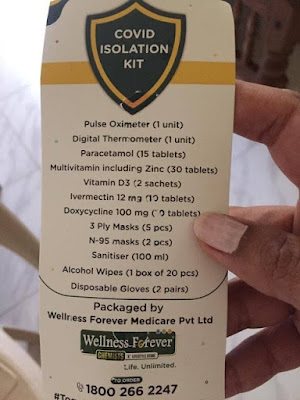
Dr. Malone followed up with a post about ivermectin in Uttar Pradesh. This site shows they've had a very low death rate compared to other Indian states, and other states mentioned in various news sources as using ivermectin likewise have had low death rates. So this is some observational evidence that ivermectin is helpful against COVID. (Others have dived far more deeply into this subject than I'm willing or able to.) He adds that a colleague on vacation in India sent him a picture of one of the COVID care packages distributed throughout the region:
Source: https://rwmalonemd.substack.com/p/socrates-thought-police-ivermectin

Assuming the contents of this pack are saving people from dying of COVID, could the other ingredients  be having an effect? Paracetamol is Tylenol, so likely nothing more than a pain reliever. Zinc--possibly. D3? Two doses, even two big ones, may or may not have much effect since it takes time for your body to build up its vitamin D level. Doxycycline is an antibiotic and an anti-inflammatory; this study didn't show any benefit for COVID patients. So maybe ivermectin is helping people.

It may not matter much at this point. It's almost all Omicron now. Even here in Indiana, where we've lagged most other places, cases are starting to go down in Indianapolis and the outskirts of Chicago. My coworkers in the suburbs of Indy are catching COVID left and right, yet I haven't heard about a serious case among them. I feel left out! One person thought I had immunity from the colds I've caught; another thought my blood type (O) helped. Thanks to immunity and repurposed drugs being treated as stepchildren, we'll probably never get a good answer to any of these questions.

Alex Berenson has written recently that COVID is over and boosters are over. Be that as it may, COVID vaccine injuries, health agency malfeasance, and the effects of the government response, all of which he writes about, are all still important. He's done some terrific reporting (aside from his latest appearance on Fox News) and for that reason I'm keeping him on the blog roll.  I still recommend his book Pandemia. If the quality of his reporting diminishes, though, I will revisit the decision to support his work.

Comments

Popular posts from this blog

Not Only Cheaper, But Easier

A while back, I wrote about saving money on break time coffee and snacks. I haven't done very well putting it into practice. But a post by James Clear today got me thinking about it again: Warren Buffett uses a two-list system to prioritize things. Check it out --and follow the instructions. Using Buffett's two-list system, two of the goals I ended up with were taking care of myself and saving $400 more per month than I already am. As I said, I've been wanting to save money, and the system made me really focus on this. I came up with 11 money-saving ideas, six of which had to do with food. Buying hamburger in bulk. Ranch Foods Direct sells one-pound packages of 80% lean pastured ground beef in bundles of 20 for a lot less than Whole Foods. Sprouts only carries super-lean beef that's grass-fed, and it's more expensive, too.  Not driving to Whole Foods. Whole Foods is out of my way, and saving a weekly trip saves gas. Coffee at home, tea at work. Tea is fr...

Moving on to YouTube

Remember when the blogosphere was a wild ride? Doctors, writers and researchers dove into research, picked apart studies and stood up to official advice and conventional wisdom that didn't work. We found each other in the comments and made a community.  Along the way, Dr. T. Colin Campbell's research got exposed as shoddy by an English major, Tom Naughton made us laugh, "safe starch" fads made us scratch our heads, "Diabetes Warrior" Steve Cooksey almost went to jail, CarbSane trolled everyone who was anyone, and CarbSaneR trolled the troll.  Now it's very quiet. Blogs don't come up in Google search results anymore and even if they did, most of the bloggers have stopped writing.  That's why I've moved on to YouTube. Videos do come up in search results and my shorts--which are mostly what I make--get pushed out to hundreds of people or more. My videos are on food and health (biohacking), but also on growing things and fixing things. If you...

We Hate the ADA; Why does the Perfect Health Diet Get a Pass?

Some people keep touting the Perfect Health Diet as low-carb, but carb levels that are mostly in the triple digits aren't generally regarded as low-carb; in fact, one of the authors says low-carb diets are unhealthy. A lot of us hate the  American Diabetes Association's advice for diabetics: start with 45g to 60g of carbohydrate per meal and go higher or lower from there. That's 135g to 180g of carb. Perfect Health Diet advice for diabetics: eat 20% to 30% of your diet as carbohydrate. On 2,000 calories, that's 100g to 150g of carb. On 1,700 calories, that's 85 to 128g; on 2,200 calories, that's 112 to 168g. Depending on your carb and calorie intake, carbs would be 85g to 168g per day. That's not a mile off from the ADA's recommendations. Paul Jaminet, one of the authors of the Perfect Health Diet, says, "the basic biology here is that the body's physiology is optimized for a carbohydrate intake of about 30%." He warns against a ...

Palpitations Gone with Iron

Thanks to my internet friend Larcana, who alerted me to the connection between iron deficiency and palpitations, I doubled down on my iron supplements and, for good measure, washed them down with Emergen-C. It's a cold medicine with a mega-dose of vitamin C, plus B vitamins and minerals. I don't think vitamin C does anything for a cold (a friend bought the stuff and left it at my house the last time she visited), but vitamin C does help iron absorption. After doubling up on iron in the last three days, I feel back to normal. (I'd already been taking quite a bit of magnesium and potassium, so I probably had sufficient levels of those.) How did I get so low on iron? Maybe it was too many Quest bars instead of red meat when I had odd cravings during my dental infection recently. Maybe because it's too hard to find liver at the grocery store and I haven't eaten much of it lately. Maybe the antibiotics damaged my intestines . And apparently, I'm a heavy bleeder . ...

My Long-Term Experience Eating Safe (and Other) Starches

Years ago, before the Perfect Health Diet came out, I followed a program that involved eating quite a bit "safe starch." It was called Body for Life. It involved eating six small servings of carbohydrate along with six small servings of protein, plus two servings of fibrous vegetables per day. (A serving was the size of your fist or the palm of your hand.) There were six workouts a week (three weightlifting, three cardio) and one free day every week where you ate whatever you wanted and didn't exercise. In all fairness, these two programs are different: BFL allows certain grains, legumes and low-fat dairy and discourages fat. It doesn't call for a wheelbarrow full of vegetation. Nevertheless, my experience eating lots of fruit and lots of starch is relevant to the PHD because the amount and type of digestible carbohydrates are similar, and for the first few years, I didn't eat wheat except on free days. At first on BFL, I felt great. Before, I was continually...