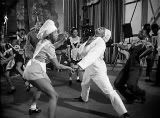
I've never understood why runners keep running until they wear out their knees. Or why dancers will dance until they have blisters on their feet.
Maybe it's good that I get too tired to run that far or dance that long. In spite of this blessing in disguise, I started getting knee pain from weightlifting. Since I didn't get knee pain during weightlifting sessions, it took me awhile to figure out what was causing it. Once I realized it was squats, I stopped doing them and felt better. However, my weightlifting routines became limited to what my joints, not my muscles, would bear, particularly for my lower body.
On the recommendation of a few bloggers I read (Dr. Michael Eades and Tom Naughton--see blog roll), I tried Slow Burn by Fred Hahn and Drs. Michael and Mary Dan Eades. The Drs. Eades explain in the beginning of the book why strength training is good for you (improved metabolism, stronger bones, more flexibility, less back pain and better athletic performance, among other things). From my own experience, I know that it improves athletic performance: once I started weightlifting several years ago, I was able to dance the way I wanted to, and an isometric neck exercise really helped my neck pain. However, I didn't see any difference in flexibility, and I still had occasional shoulder pain. As for stronger bones, as a small, white, thin-boned female, I hope they're right.
The workout itself involves slow, grueling movements with heavy weights or the weight of your own body. Think pushups that last 20 seconds each--and no propping yourself up on your arms. The sets are brief, though: just 90 seconds, it only feels longer. The goal is muscle failure: to do the exercise until you can no longer move the weight. As smart weightlifters say, muscle building happens fast or not at all. It's only been in the past few workouts that I've discovered the correct weights for this--and started feeling like I worked out.
So far, this has worked well for my upper body, but I'd probably have to go to a gym to use machines and larger weights to get the most benefit for my lower body. For example, the squats described in the book are difficult, but even going all the way down, I don't have muscle failure. (I do lindy, and I don't know of anything better to strengthen your quadriceps.) I don't even bother with the heel raises, since I could do them all day. The recommended crunches don't work for me (I'm short-waisted) so I do Navy Seal flutter kicks with my head off the floor instead. If a 118-pound woman can't get lower-body muscle failure with home equipment, I imagine that big, strong women and most men would have to use a gym to make this work.
The Slow Burn system requires a few pieces of equipment: a yoga mat, a towel, weights, a metronome and a timer. I downloaded a free timer from cnet.com and found a free online metronome at metronomeonline.com.
Did I mention this is a quick workout? It really does last only about 30 minutes per week. (Originally, I wrote that this is a once-a-week workout, but Fred Hahn has informed me that it's better to do it twice a week, or once a week if you are a very athletic person. See comments.)
Comments
My book has two workouts in it as you know - a home based program which you are trying and a gym program. You are absolutely right that most in shape men and women need to go to a gym to get the most out of any training system.
About the squats - if you notice the section on making the exercises harder I suggest using an extremely slow speed on both the lift and the lower - did you try that yet? What I should have added is a dumbbell or water jug Slow Burn squat. (I did for my kids book.)Try using either of these tools to add resistance to the squats. Just keep your toes in front of your knees at all times, head up, back arched. You could also try one-legged door knob squats! (Same for the heel raises.)
With crunches the length of your waist doesn't matter. Flutter kicks strengthen your hip flexors - not your rectus abdominus that much. These muscles main function is spinal flexion. Try the negative (lowering) only crunches. If done right, these will burn your abs out of your body! ;)
And we don't say once a week - we say thirty minutes a week. We recommend twice weekly training. There is one point in the book (an error) that says you only need to do this once a week but several other areas where we say twice. Twice is better UNLESS you are an very active athletic person. Then once will be better to allow for recovery.
And while dancing is wonderful, dancing will not keep your lower body from losing muscle mass as you age. As you mentioned above:
"From my own experience, I know that it improves athletic performance: once I started weightlifting several years ago, I was able to dance the way I wanted to..."
So if you love dancing, strength train so that you can continue into your later years! Feel VERY free to email me with any questions and thank you for reading my book and blogging about it VERY much. :)
A twice-a-week program makes more sense; I don't think most of us need a week to recover. The once-a-week assumption seems like a common misconception. Maybe we're all so used to long workouts that we assume 30 minutes can't equal more than one session.
Having studied several forms of social dance, belly dance and ballet, I agree that in general, you could dance to the break of day every weekend without seeing much muscle gain. But lindy (and possibly ballet) are exceptions. If you have a traditional bent-kneed, hips-out stance (not unlike doorknob squats), it will strengthen your quadriceps. See girl in photo I've added to the post.
My thighs were killing me when I started lindy lessons! Add a constant, gentle bounce that most social dances don't have, and your calves and feet gain some strength as well. As for glutes, I don't see many lindy hoppers with flat rear-ends.
Be that as it may, I still intend to do lower-body Slow Burn strength training, especially now that you've given me some good ideas. I'd love to still be dancing into my 90s, as Frankie Manning did (he's the guy in the overalls).
Thanks again for your helpful comments.